
Cuyahoga Land Bank-Benedictine Partnership Benefits Buckeye Neighborhood
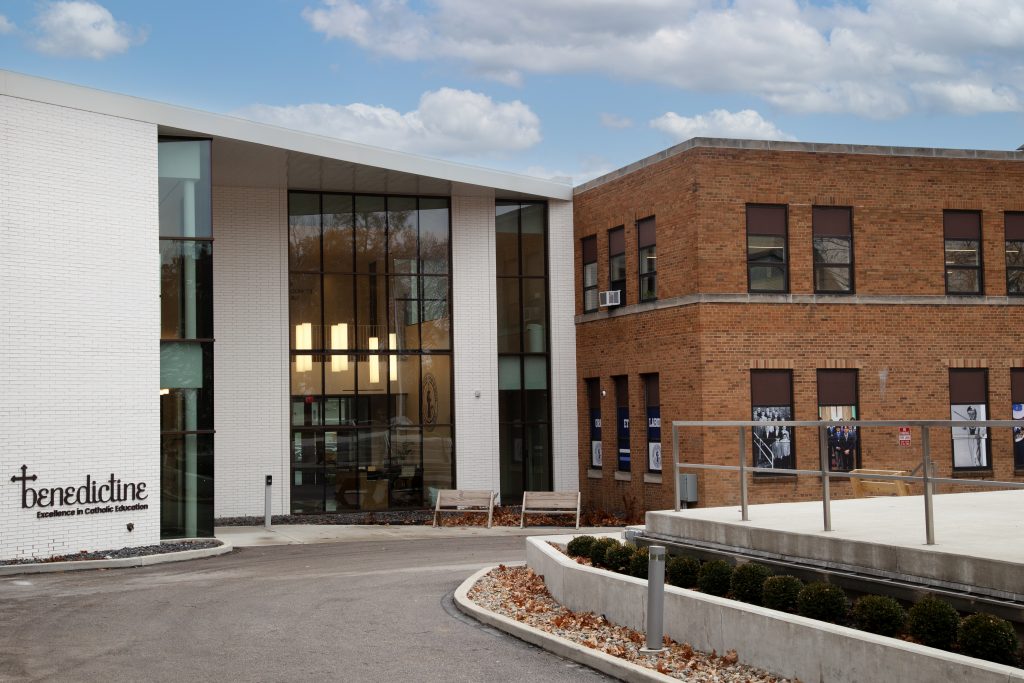
For nearly 100 years, Benedictine High School has been an anchor, a consistent presence really, on the southern border of East Cleveland in the Buckeye neighborhood.
The all-boy’s high school was established in 1927 by the monks of St. Andrew Abbey who settled in what back then was an Eastern European immigrant neighborhood.
The current high school, built around 1939, is still in use and shares a 13-acre campus, with a monastery, abbey, field house and football field.
In the 1950s and 1960s, when enrollment at Benedictine was at its peak, the Buckeye neighborhood was known as “Little Hungary” and considered the epicenter of the largest population of Hungarians outside of Hungary. During that time, Dave Schroeder, President of Benedictine High School, explains that school enrollment grew to about 1,000 students.
In the 1970s the school’s demographics changed with the neighborhood, which, like many in Cleveland, saw a significant population loss compounded by a massive homeowner shift during the 2008 foreclosure crisis.
“The neighborhood, since the monks opened the school, has changed but the monks take a vow of stability; and even when they’ve had the opportunity to leave the Buckeye community, they stayed true to their mission,” Schroeder added.
Today, around 300 students attend Benedictine and Schroeder said he is looking to grow that number while simultaneously supporting local development. He wants to do this by leveraging the school’s longstanding relationship Cuyahoga Land Bank.
Assembling land to help build out the campus is where Cuyahoga Land Bank’s Director of Acquisition and Disposition, Kim Steigerwald comes in.
The Land Bank, Steigerwald explains, has a history of helping the school find, acquire and manage properties around the campus. Steigerwald utilizes a series of maps customized for Benedictine to identify properties at risk or heading into tax foreclosure and forfeiture.
“We will let the school know if there is a property they can bid on or the Land Bank will bid on,” she said. “We acquired a vacant house adjacent to their entrance that was in really bad shape and owned by Fannie Mae. Since we have a long-standing relationship with Fannie Mae, we were able to acquire it, and then we tore it down and passed the land to the school.”
Steigerwald will bid on Sheriff Sale properties if needed and take care of all the paperwork – conveyance agreements, purchase agreements, deed search and even filing with Cuyahoga County.
The Land Bank handles all the property development details so that Schroeder and staff can focus on Benedictine’s core mission of educating students.
“The Land Bank is low touch;- we get a phone call asking, ‘Are you interested in this property?’ And then the next thing I know, I’m asked to signand submit a payment. It is a turnkey type of relationship that saves me a ton of time, and it saves us from having to go out and hire third party realtors or developers,” Schroeder said.
The acquisition of vacant and blighted properties throughout the neighborhood with the help of the Land Bank serves multiple goals, Schroeder stresses.
Schroeder points to the fact the 91 students in Benedictine’s freshman class have come from 54 different schools – some as far as Newburry from the east, Elyria from the west and as far south as Canton, adding that the goal is “to put our best foot forward, make families feel safe sending their students here.” He also wants to ensure the school contributes to the resurgence of the Buckeye neighborhood.
“We anticipate our enrollment to continue to grow, and we are adding additional programming to the academic side, which will require us to have new facilities. But in addition to growing the campus footprint,we also want to be a catalyst for the Buckeye area transformation happening in the area with the Opportunity Corridor.”
The construction of the Opportunity Corridor, just south of Benedictine, significantly improves the school accessibility, reducing commute times for students, and is a big part of the school’s marketing and enrollment push, Schroeder said.
Partnering with the Land Bank and having a long, constant presence in the Buckeye community affords a level of trust as the school looks at properties outside of the campus footprint.
Urban schools like Benedictine, he said, are looked at as an anchor in the community and if capable, can help broker and drive housing and commercial investment.
“When we are opportunistic in acquiring local properties, Buckeye benefits from having less vacant and under-utilized land. We also feel like we’re doing our part, for our students and the community, if we can help bring a new restaurant or retail tenant to some of these vacant properties,” Schroeder explains.
The work and partnership between Benedictine and the Land Bank to transition the Buckeye properties back into productive use, Schroeder said, is an example of values and principles in alignment.
“We look for partners that share values with Benedictine. And I think some of the values and the principles that the Cuyahoga Land Bank should stand for is also very important to us and what they provide the community.”
