
Land for a Purpose: How Cuyahoga Land Bank Helps Power Green Infrastructure Across the County
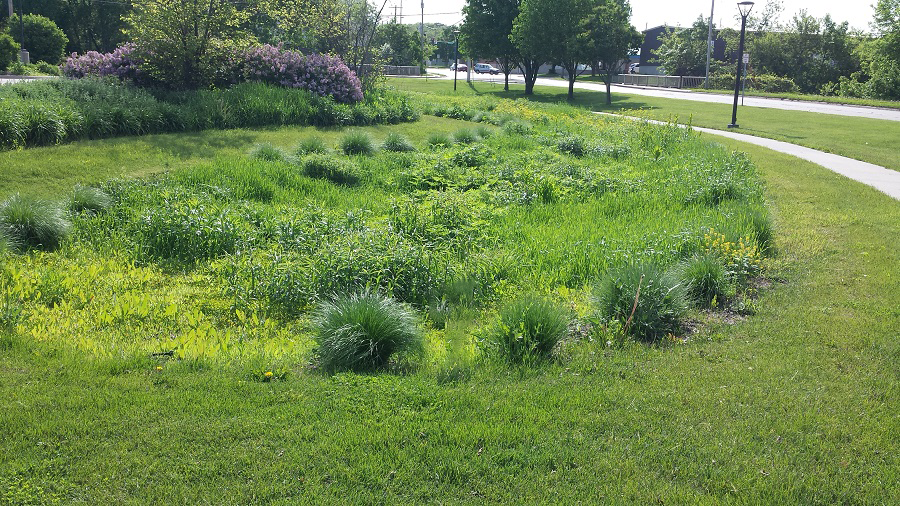
For more than a decade, Cuyahoga Land Bank has played a quiet but critical role in strengthening our region’s infrastructure not just by returning vacant properties to productive use, but by strategically assembling land that protects public health and waterways.
One important partnership in achieving this eco-conscious goal is with the Northeast Ohio Regional Sewer District (NEORSD). Their team transforms vacant land into green infrastructure that reduces flooding, prevents pollution and improves water quality throughout Cuyahoga County.
A Partnership Built on Good Maps
“Since 2010, the Northeast Ohio Regional Sewer District has been approaching us looking for assistance in acquisition of vacant lots and which we are happy to do,” said Kim Steigerwald, Director of Acquisition & Disposition for Cuyahoga Land Bank. “We will acquire them through end users, donations and tax foreclosure.”
The Land Bank’s unique statutory tools allow the organization to assemble properties that would otherwise remain fragmented or underutilized. Steigerwald explained: “The folks at the sewer district know exactly what they need, where they need it and when they need it. And their mapping abilities are amazing, so when they see that there’s something in their area that we own, we’re happy to oblige.”
This coordination matters. Stormwater infrastructure is not random; it must be carefully located within a watershed to maximize impact. When NEORSD identifies a priority site, the Land Bank can move strategically to secure it.
“We acquire vacant lots for them in their targeted areas to help with various projects including the creation of bioretention cells,” Steigerwald added.
How Land Matters to the Sewer System
Much of Cleveland operates under a combined sewer system. As Chris Hartman, Stormwater Technical Specialist with NEORSD, explained: “A combined sewer system is when all water flows to a single pipe. All the sanitary waste and all the stormwater inlets are connected to that single pipe, which conveys the flow to the waste water treatment plant.”
On dry days, that system works efficiently. Even during light rain, it generally performs well. But heavy storms create a surge.
“When a lot of stormwater mixes with the sanitary waste, those pipes no longer have the capacity to convey it all the way to the treatment plant,” Hartman said. “Only what can fit in the pipe gets to the treatment plant and what enters that second pipe, the overflow pipe, gets discharged into the environment.”
That discharge carries untreated stormwater, pollutants and sanitary wastes into Lake Erie, the Cuyahoga River, and local streams – waterways used for recreation, fishing and as a drinking water source.
“We’ve all seen the bacteria warnings for Edgewater Park, right? That’s the kind of thing bioretention cells help to address,” Hartman explained.
Reducing the volume and pollution of stormwater before it enters the system is essential. That’s where bioretention cells come in.
What Is a Bioretention Cell?
“Bioretention is a stormwater control measure,” Hartman explained. “It’s a landscaped bed that’s in the shape of a bowl that purposely collects the runoff at the low point.”
He describes it like a three-layer cake:
- Bottom layer: Gravel that allows stormwater to properly drain.
- Middle layer: Sandy soil that slows water just enough for pollutants to be filtered out.
- Ponding layer: Mulch and plants that trap hydrocarbons and allow sunlight and microbes to break down contaminants.
“The soil and plants remove pollutants like hydrocarbons, phosphorus and nitrogen through a variety of processes like filtration, sedimentation, adsorption, plant uptake and microbial activity,” Hartman noted. “So, in the end, the water is coming out much cleaner.”
If water cannot fully infiltrate into the ground, underdrain pipes at the gravel level return it to the sewer system cleaner than when it left the street or parking lot.
Why Bioretention Cells Are Important
Before bioretention, stormwater washing across parking lots and streets carried pollutants directly into pipes and then into streams, the Cuyahoga River and Lake Erie.
“Parking lot runoff is pretty nasty,” Hartman said. “When your tires and brakes wear, when a drip of oil comes off a leaky gasket, that stuff doesn’t just disappear. Those pollutants go directly to the environment.”
These pollutants accumulate on hard surfaces and are flushed into waterways during rainstorms. Bioretention cells intercept and treat that runoff before it causes harm.
“A lot of the pollutants that come into the bioretention cells will stay there, which means less impact to our recreational and public uses of these water resources,” Hartman added.
By capturing stormwater at its source, bioretention cells:
- Reduce combined sewer overflows
- Improve water quality
- Protect beaches and recreational areas
- Enhance neighborhood green space
- Increase climate resilience amid more frequent heavy rain events
Land as Infrastructure
None of this is possible without land.
As Lilah Zautner, Project Manager for Property Acquisition at NEORSD, explains, “Cuyahoga Land Bank and NEORSD work together closely. The District partners with the Land Bank on acquisitions across the service area, leveraging the Land Bank’s unique acquisition and assembly tools to support the Stormwater program.”
Land Bank-acquired land may be used for major tunnel projects, preservation around stormwater systems, or distributed green infrastructure like bioretention cells. Vacant lots that once symbolized disinvestment can become high-performing environmental assets.
Turning Vacant Lots Into Environmental Assets
Blight removal is just the first step to Cuyahoga Land Bank achieving their mission of repurposing land back to productive use. Only through intentional land assembly, partnership and strategy can smart redevelopment and critical public infrastructure be enabled.
By acquiring and holding land in targeted areas, Cuyahoga Land Bank ensures that when partners like NEORSD identify a need – whether for a major capital project or a neighborhood-scale bioretention cell – the right property is available at the right time.
In a region shaped by water, protecting that resource is a shared responsibility. Through this partnership, vacant land becomes part of the solution to filter runoff, prevent pollution and safeguard the Cuyahoga River and Lake Erie for generations to come.
Land, when used with purpose, is powerful infrastructure.
